 ANZBMS 2026
 Clinically Interpretable Predictors of Imminent Subsequent Fractures in a Deep-Learning Prediction Model (#55)
The inherent “black-box” nature of machine- and deep-learning models, despite their reported superiority in predictive performance, limits their adoption in clinical practice. Clinicians require interpretable predictions that can justify individualised treatment decisions. This study aimed to quantify and characterise the relative importance of predictors in a deep-learning algorithm for imminent subsequent fracture risk, facilitating clinical interpretability and supporting its intended deployment within electronic health records.
We developed a DeepHit prediction model for subsequent fractures using administrative health data from a statewide population-based cohort of 280,686 adults in New South Wales, Australia, including adults who sustained an incident fracture, requiring hospital or emergency admission between Jan 2005 and Jan 2017 and were followed through to Jan 2019, born on or before 1955. Predictors included age, index fracture site, history of prior fractures or falls, and 1,805 ICD-10 codes mapped to 60 pre-defined chronic diseases related to fracture and mortality risk. We used a SHapley Additive exPlanations (SHAP) to quantify each predictor’s contribution across all possible predictor subsets.
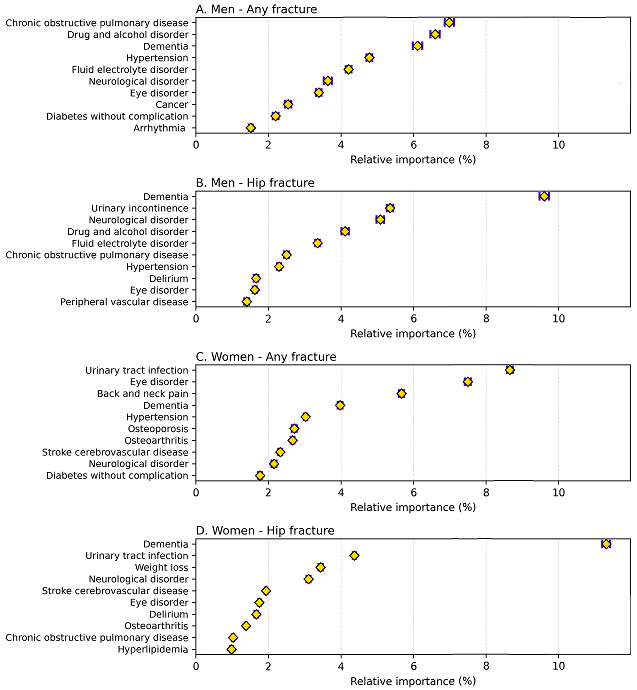
Over a median follow-up of 2.0 years (IQR, 1.6 - 2.0), 7,002 men and 21,167 women were admitted with a subsequent fracture, corresponding to incidence rates of 53.3 (95% CI, 52.1 - 54.6) and 64.8 (64.0 - 65.7) per 1,000 person-years, respectively. The model showed strong discrimination and calibration for 1- and 2-year risks of subsequent fractures, with minimal prediction bias (~ zero), and C-indices of up to 0.81 for hip and 0.75 for any subsequent fractures. Age at index fracture was the dominant predictor, accounting for 20% of the predictive contribution for any subsequent fractures in men and up to 34% for hip fractures in women. Index fracture site was consistently influential, contributing 8-14% of the overall predictive performance. Among comorbidities, lung disease, dementia, urinary tract infections or incontinence, drug- or alcohol-related disorders, eye and neurological conditions were the strongest contributors to the prediction of imminent subsequent fracture risk (Figure).
This study identifies clinically meaningful predictors of imminent subsequent fractures. It demonstrates that explainable deep-learning models can provide accurate predictive performance while remaining interpretable and transparent, thus supporting targeted secondary fracture prevention.