 ANZBMS 2026
 A Novel Deep Learning Application to Predict High-risk Fracture Patients for Imminent Non-Fracture Re-Hospitalisations (#54)
arly identification of patients at high risk of post-fracture consequences is essential for optimising post-fracture care. We developed and validated a deep learning-based model to predict the imminent risk of non-fracture re-hospitalisation following a fragility fracture using routinely collected administrative data.
This statewide, whole-of-population retrospective cohort study included 84,165 men and 196,521 women in New South Wales, Australia, born on or before 1/1/1955, who sustained an incident fracture between 2005 and 2017 and were followed through 2022. Fractures and relevant comorbidities associated with fracture risk and mortality were identified using ICD-10 codes recorded within five years of the index fracture. The primary outcome was substantive non-fracture re-hospitalisation, defined as episodes of care lasting ³24 hours and occurring ³7 days post-fracture. A DeepHit neural network model was employed to estimate 1- and 2-year risks of non-fracture re-hospitalisations, accommodating high-dimensional predictors, nonlinear relationships, and competing risks of subsequent fractures and death. Predictors included age, fracture sites, prior falls or fractures, and 1,870 individual ICD-10 codes for 65 predefined comorbidities. Data were randomly partitioned into training (70%), validation (10%), and hold-out testing (20%) sets.
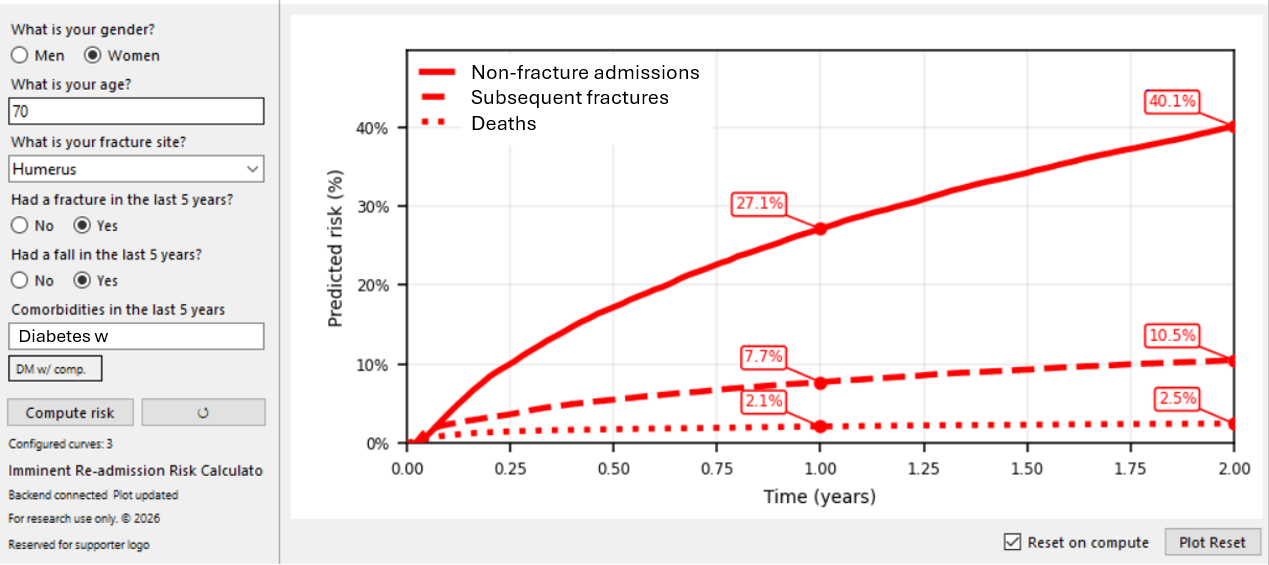
Over a median follow-up of 1.5 years (IQR: 0.4–2.00), 39,742 men and 76,963 women experienced at least one non-fracture re-hospitalisation, yielding the incidence of 42.7 (95% CI: 42.2-43.1) and 30.7 (30.4-30.9) re-hospitalisations/100 person-years, respectively. Leading re-hospitalisation reasons included cardiovascular disorders (heart disease 6.2%, ischaemic heart disease 3.7%, and cerebrovascular disease 2.7%), respiratory disorders (influenza/pneumonia 4.0%, chronic lower respiratory diseases 3.5%), malignancies (5.8%), and arthropathies (5.6%). Competing event rates for subsequent fracture and mortality rates were 4.4 (95% CI: 4.3-4.6) and 10.0 (9.8-10.2)/100 person-years in men, and 5.6 (5.5-5.7) and 6.1 (6.0-6.2)/100 person-years in women, respectively. The model showed good discrimination [C-index: 0.77 (95% CI: 0.76–0.78) in men; 0.75 (0.75–0.76) in women] with modest overestimation of absolute risk (bias ~ -0.02). A user-friendly application was developed to estimate individualised risk predictions, supporting clinical implementation (Figure).
Our model accurately identified patients at imminent risk of non-fracture re-hospitalisations using administrative data, suggesting its potential for automated risk stratification within the healthcare system.