 ANZBMS 2026
 Powerful engine, fragile chassis: lower bone mineral density in elite male cyclists despite high aerobic fitness (#37)
Background: Cycling is a high-volume endurance sport that enhances aerobic capacity with minimal osteogenic loading. Subsequently, cyclists may be at risk of low bone mineral density (BMD) and fractures. Yet the relationships between cardiorespiratory fitness, body composition, and bone variables in this population remain unclear. Therefore, we aimed to assess differences in areal BMD (aBMD) between male elite cyclists and controls; and whether alterations in body composition and aerobic fitness contribute to any differences.
Methods: In a cross-sectional study of 103 men (62 cyclists, 41 controls), dual-energy X-ray absorptiometry (DXA) measured aBMD at the total hip, femoral neck and lumbar spine; body composition was measured with a whole-body scan. VO₂peak and physical activity measures were collected. Linear regression models examined associations between age, appendicular lean mass index (ALMI), fat mass index (FMI) and VO₂peak, and bone variables, including group interaction terms. Bone variables were log transformed to normalise distributions prior to regression analysis. Variables are presented as B-coefficients expressed as a percentage change in the tested independent variable with 95% confidence intervals.
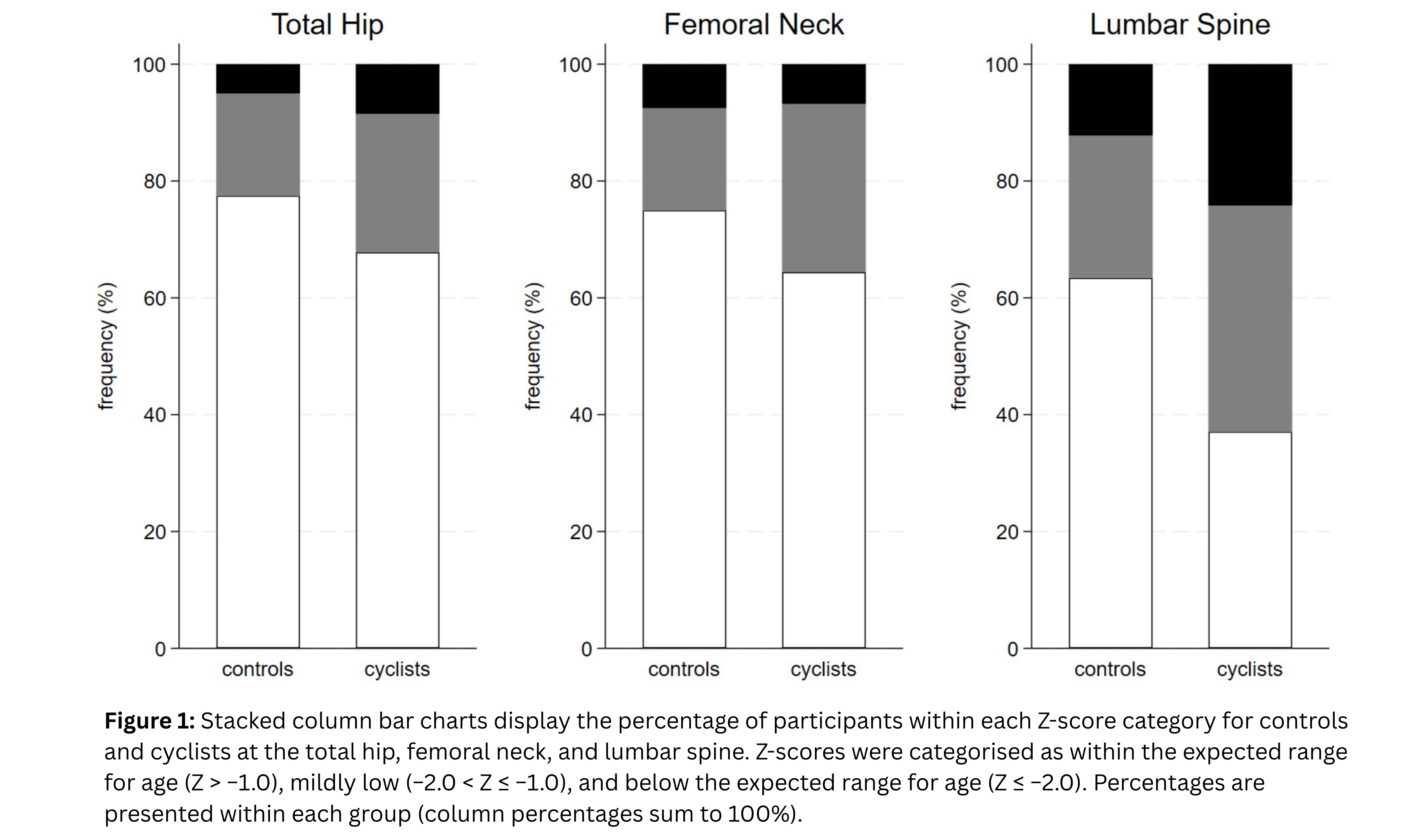
Results: Cyclists had significantly lower mean total hip, femoral neck and lumbar spine aBMD compared with controls (all P≤0.002). Z-scores were significantly lower in cyclists compared with controls at all skeletal sites (total hip: -0.62 vs -0.13; femoral neck: -0.71 vs -0.18; lumbar spine: -1.22 vs -0.40); there was a greater proportion of cyclists in the lower Z-score categories, most pronounced at the lumbar spine (Figure 1). ALMI was a strong positive predictor of aBMD at all sites in both groups. FMI and age were not significant predictors. VO₂peak was positively associated with aBMD in controls but showed weaker associations in cyclists (total hip aBMD: 10.6% (4.5, 16.8) vs 1.8% (-3.7, 7.3), p-int=0.03; femoral feck aBMD: 12.6%(6.2, 18.9) vs 1.9%(-3.9, 7.6), p-int=0.01).
Conclusion: Elite cyclists have lower aBMD despite superior aerobic fitness. While lean mass is a consistent determinant of bone health, the positive relationship between BMD and cardiorespiratory fitness was not apparent in cyclists. Reduced aBMD in cyclists may be explained by the mechanical loading profile of cycling and the impact of low energy availability.