 ANZBMS 2026
 Body composition indices, physical function, and risk of fall and fracture in middle-aged adults: the Busselton Healthy Ageing Study (#38)
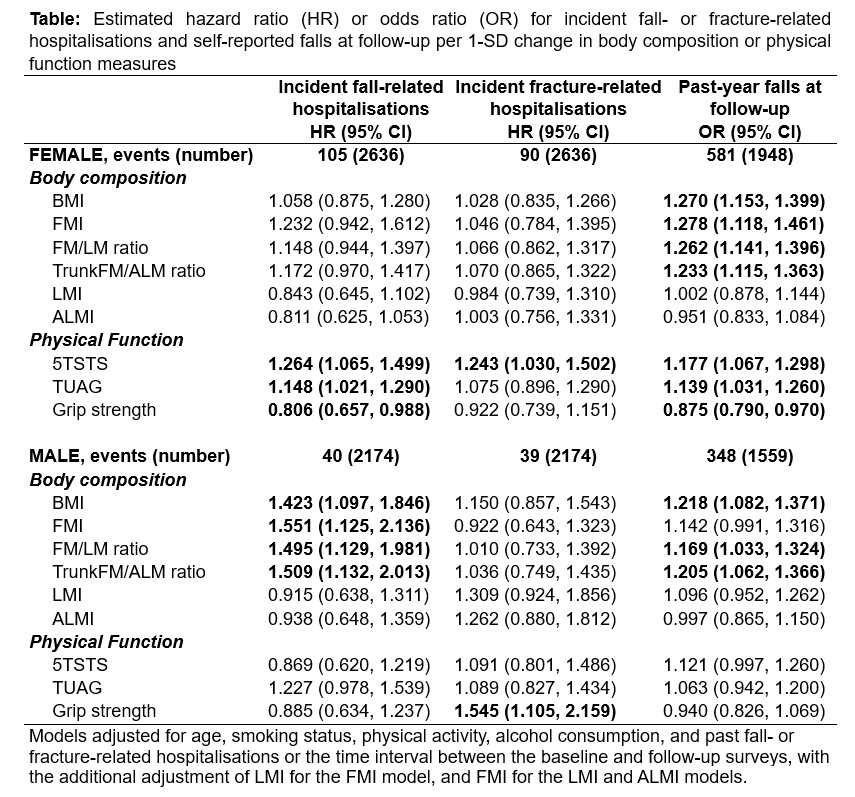
Few prospective studies have examined risk factors for falls and fractures in middle-aged adults. We investigated associations between body composition, physical function, and fall and fracture risk in 4,810 participants of the Busselton Healthy Ageing Study (54.8% female, aged 46–69 years). Baseline measures included BMI and DXA-derived fat (FMI), lean (LMI), and appendicular lean mass index (ALMI), FM/LM ratio, and trunk FM/ALM ratio. Grip strength, Timed Up and Go (TUAG), and Five Times Sit-to-Stand (5TSTS) were assessed at baseline and follow-up (~6 years). Fall- and fracture-related hospitalisations over a median 7.9-year follow-up were captured via data linkage; self-reported falls in the preceding 12 months were collected at follow-up (n=3,507). Cox proportional hazards and logistic regression models assessed associations, adjusting for demographic and lifestyle covariates. Post-baseline, 145 and 129 participants experienced fall- and fracture-related hospitalisations, respectively, and 929 reported a fall at follow-up. Each 1-SD increase in baseline BMI, FMI, FM/LM, and TrunkFM/ALM was associated with greater fall-related hospitalisation risk in men (HR 1.42–1.55), and in both sexes, higher odds of self-reported past-year falls (OR 1.17–1.28) and worse TUAG and 5TSTS performance at follow-up (2.3–4.4%). In women, each 1-SD worse baseline physical function was associated with 12–26% higher risk of fall-related hospitalisation and self-reported falls, and a 24% higher fracture-related hospitalisation risk per 1-SD slower 5TSTS. LMI and ALMI were largely unassociated with outcomes, except for modestly slower 5TSTS at follow-up (1.6%). In middle-aged adults, higher adiposity indices were associated with fall risk and physical function decline, while poorer physical function predicted falls and fractures in women, highlighting the importance of addressing both in fall prevention strategies.