 ANZBMS 2026
 When bone meets blindness: a case of osteoporosis-pseudoglioma syndrome complicated by atypical femur fracture (#208)
Background
Osteoporosis-pseudoglioma syndrome (OPPG) is a rare genetic cause of juvenile osteoporosis associated with significant morbidity due to childhood skeletal fragility. Management evidence is limited to case reports/series.
Presentation
A 52-year-old male with OPPG diagnosed in his early 40s by Professor Emma Duncan with compound heterozygosity for pathogenic variants in low-density lipoprotein receptor-related protein 5 (LRP5) gene (c.4448+2T>G and c.1451T>G), presented for ongoing management. He was blind from birth and had sustained multiple fractures including first fracture of the ankle at age 3, multiple long-bone fractures, clavicle fracture, extensive vertebral fractures (only C2-4 spared) and an atypical femur fracture (AFF) after ~10 years of bisphosphonate therapy. He mobilises with two gait aids.
His history includes hypogonadotropic hypogonadism (on Testogel), obesity, obstructive sleep apnoea, gout, asthma, depression and childhood seizures. He does not use glucocorticoids, is a nonsmoker and consumes 3-4 standard drinks of alcohol per week. His parents are heterozygous carriers of the pathogenic LRP5 variant; his brother is unaffected and he has no children.
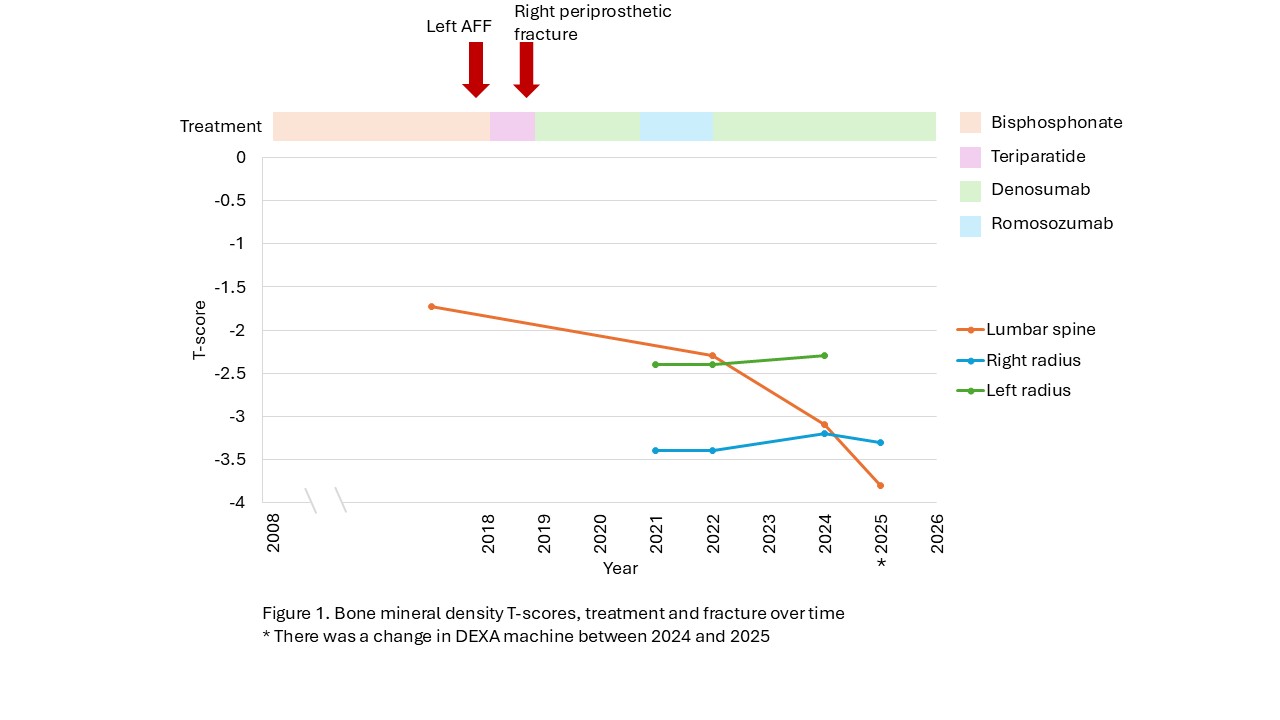
Treatment regimen and changes in bone mineral density (BMD) are in Figure 1. Of note, after suffering an AFF, treatment was changed to teriparatide for 18 months, followed by denosumab. He completed 12 months of romosozumab from May 2021 with stable BMD. He is currently maintained on denosumab, with no further fractures since 2019.
Discussion
OPPG is a rare autosomal recessive disorder characterised by juvenile osteoporosis and congenital blindness (1). The estimated incidence is ~1/2,000,000 with ~80 cases reported (2, 3). It is caused by a loss-of-function homozygous or compound heterozygous mutation in the LRP5 gene on chromosome 11q13 (4). LRP5 is essential for bone metabolism via the Wnt signalling pathway, promoting osteoblast maturation and inhibiting osteoclast differentiation (1). Disease manifestations cause significant morbidity due to blindness, recurrent fractures, deformity of extremities and chronic pain often resulting in progressive disability with our patient experiencing leg bowing and requiring two canes for mobility and vision.
AFFs are most commonly associated with anti-resorptive therapy, particularly bisphosphonates (5). AFF risk may also be increased in OPPG potentially related to LRP5-associated low bone turnover, impaired bone remodelling and possibly weakened trabecular structure predisposing to cortical breaks (6). A novel biomarker for bone fragility, termed ‘bone disorganisation’ may also be implicated in the pathogenesis of AFF (7). There is little evidence to guide pharmacological management post AFF. Teriparatide may be an effective option to enhance bone healing (8). An individualised risk assessment of medical therapy needs to be considered, as in our case where the benefits of a relatively lower AFF risk anti-resorptive drug (denosumab) in the setting of severe osteoporosis and high fracture risk, likely outweighs the rare risk of AFF.
Due to the rarity of OPPG, evidence for management is limited to case reports/series. Bisphosphonates have most commonly been used for 2-7 years duration, with decreased bone pain and improved BMD Z-scores without adverse effects, however majority (7/11) still sustained fractures (2, 3, 9). There are case reports of short-term denosumab and teriparatide resulting in improved BMD (10-12), although the longer-term effects are unknown.
As OPPG results in decreased bone formation, anabolic agents such as romosozumab are of interest to improve bone quality. Romosozumab is a monoclonal antibody to sclerostin, an antagonist of the Wnt pathway. Sclerostin binds to LRP5/6 receptors to inhibit osteoblast differentiation and bone formation (13). Romosozumab efficacy in OPPG may be reduced due to absent/defective LRP5. However, animal studies show that LRP5-deficient mice still respond to anti-sclerostin treatment with increased trabecular and cortical bone formation and BMD (14). It is suggested that the anabolic effects of anti-sclerostin therapy may occur through alternative Wnt signalling pathways (such as LRP4/6) and those with LRP5 variants may potentially be more reliant on these alternative pathways resulting in significant bone mass gains (14). The skeletal effects of romosozumab in patients with OPPG are unknown. Our case demonstrated stable BMD with romosozumab treatment.
Conclusions
- OPPG is a rare autosomal recessive disorder due to pathogenic mutations in LRP5 causing juvenile-onset osteoporosis and congenital blindness, resulting in significant childhood morbidity secondary to blindness and fracture-related morbidity.
- AFF risk is possibly increased in OPPG due to low bone turnover, impaired bone remodelling and bone disorganisation.
- Pharmacological management post AFF should be individualised with careful consideration of risk vs benefit of anti-resorptive therapy.
- Treatments for OPPG are not well established with most evidence for bisphosphonates, however it may not prevent ongoing fractures.
- Romosozumab may be a useful anabolic agent in OPPG despite LRP5 deficiency, as evidenced in murine studies and our case.
- Ai M, Heeger S, Bartels CF, Schelling DK. Clinical and molecular findings in osteoporosis-pseudoglioma syndrome. Am J Hum Genet. 2005;77(5):741–53.
- Papadopoulos I, Bountouvi E, Attilakos A, Gole E, Dinopoulos A, Peppa M, et al. Osteoporosis-pseudoglioma syndrome: clinical, genetic, and treatment-response study of 10 new cases in Greece. Eur J Pediatr. 2019;178(3):323–9.
- Abdel-Hamid MS, Elhossini RM, Otaify GA, Abdel-Ghafar SF, Aglan MS. Osteoporosis-pseudoglioma syndrome in four new patients: identification of two novel LRP5 variants and insights on patients' management using bisphosphonates therapy. Osteoporos Int. 2022;33(7):1501–10.
- Gong Y, Slee RB, Fukai N, Rawadi G, Roman-Roman S, Reginato AM, et al. LDL receptor-related protein 5 (LRP5) affects bone accrual and eye development. Cell. 2001;107(4):513–23.
- Black DM, Geiger EJ, Eastell R, Vittinghoff E, Li BH, Ryan DS, et al. Atypical Femur Fracture Risk versus Fragility Fracture Prevention with Bisphosphonates. N Engl J Med. 2020;383(8):743–53.
- Alonso N, Soares DC, E VM, Summers GD, Ralston SH, Gregson CL. Atypical femoral fracture in osteoporosis pseudoglioma syndrome associated with two novel compound heterozygous mutations in LRP5. J Bone Miner Res. 2015;30(4):615–20.
- Zebaze R, Shore-Lorenti C, Nguyen HH, Chiang C, Milat F, Ebeling PR. A Quantification Method for Disorganized Bone Components: Application to the Femoral Shaft. JBMR Plus. 2023;7(2):e10713.
- Salamah HM, Abualkhair KA, Kamal SK, Mohamed HA, Alkheder A, Farho MA, et al. The effect of teriparatide on patients with atypical femur fractures: a systematic review and meta-analysis. Arch Orthop Trauma Surg. 2024;144(3):1091–106.
- Streeten EA, McBride D, Puffenberger E, Hoffman ME, Pollin TI, Donnelly P, et al. Osteoporosis-pseudoglioma syndrome: description of 9 new cases and beneficial response to bisphosphonates. Bone. 2008;43(3):584–90.
- Miyazawa S, Nakamura Y, Kosho T, Kawame H, Narumi S, Hasegawa T, et al. Efficacy of denosumab therapy for osteoporosis-pseudoglioma syndrome with osteoporosis: a case report. Modern Rheumatology Case Reports. 2019;3(1):45–8.
- Arantes HP, Barros ER, Kunii I, Bilezikian JP, Lazaretti-Castro M. Teriparatide increases bone mineral density in a man with osteoporosis pseudoglioma. J Bone Miner Res. 2011;26(12):2823–6.
- Homaei A, Chegini V, Saffari F. Clinical Response to Treatment with Teriparatide in an Adolescent with Osteoporosis-Pseudoglioma Syndrome (OPPG): A Case Report. Int J Endocrinol Metab. 2022;20(2):e121031.
- Canalis E, Giustina A, Bilezikian JP. Mechanisms of anabolic therapies for osteoporosis. N Engl J Med. 2007;357(9):905–16.
- Kedlaya R, Veera S, Horan DJ, Moss RE, Ayturk UM, Jacobsen CM, et al. Sclerostin inhibition reverses skeletal fragility in an Lrp5-deficient mouse model of OPPG syndrome. Sci Transl Med. 2013;5(211):211ra158.