 ANZBMS 2026
 A Skeleton in the Genome: Digenic Inheritance Unmasking a Progeroid Bone Fragility Syndrome (#30)
Background
Werner syndrome and related progeroid disorders are rare conditions characterised by premature ageing, low bone turnover, and multisystem involvement. Digenic inheritance of heterozygous variants in Werner-spectrum genes represents an emerging and underrecognised mechanism by which a full progeroid phenotype may be expressed.1 Here we present a case of a woman with a complex progeroid-like syndrome — initially labelled as osteogenesis imperfecta of undetermined type — whose underlying diagnosis may have been clarified through whole-genome sequencing, though considerable diagnostic uncertainty remains, with significant implications for management across multiple organ systems.
Case Presentation
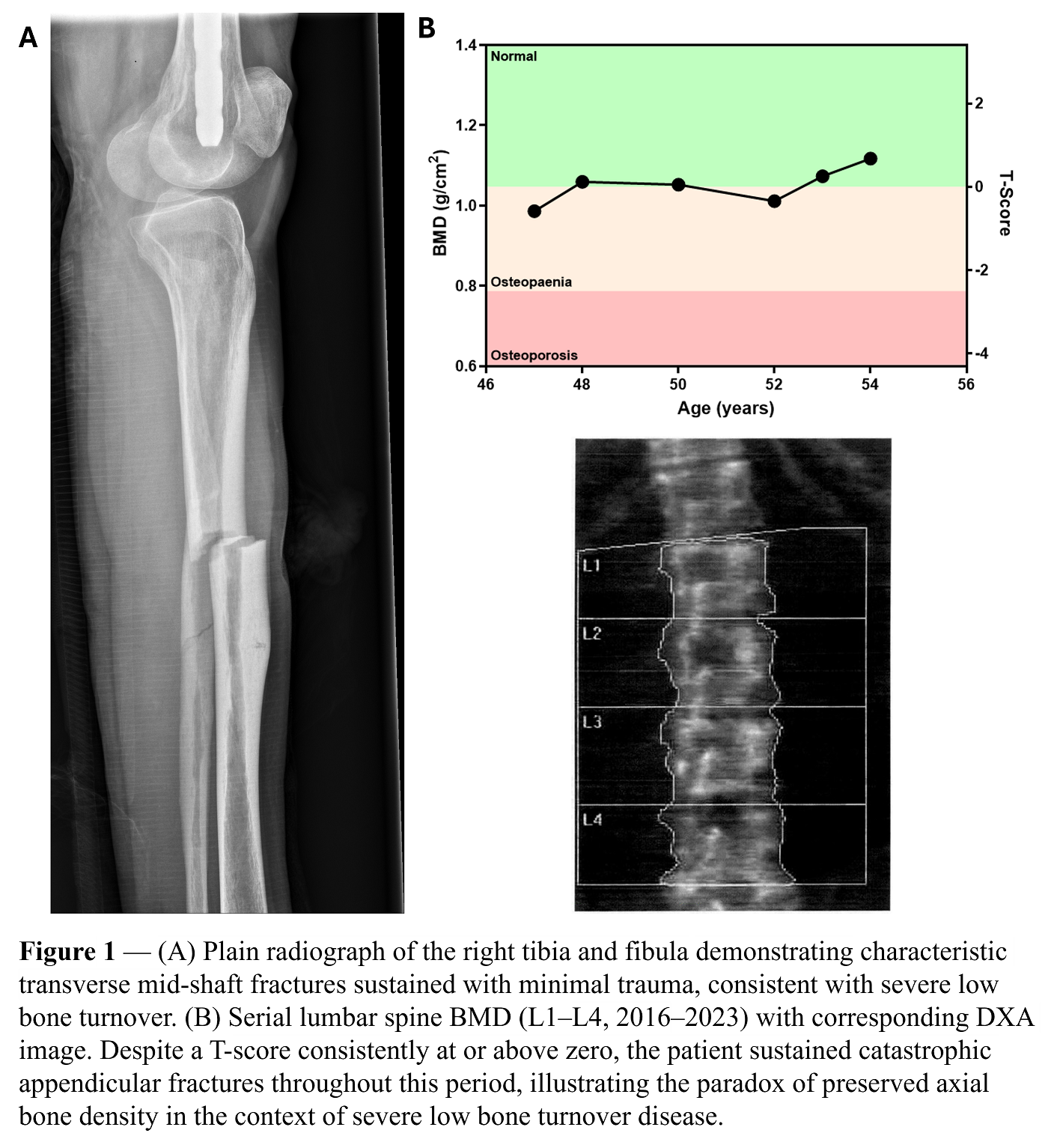
The patient is a 57-year-old woman with recurrent stress fractures since age 11. Initial evaluation was consistent with a low bone turnover bone fragility disorder; bone biopsy in 2008 demonstrated markedly reduced bone volume and remodelling, reported as compatible with osteogenesis imperfecta of unknown type, though standard genetic testing for COL1A1/COL1A2 and other known OI-associated genes failed to identify a causative mutation. Whole-genome sequencing subsequently identified digenic heterozygosity for CTC1 p.V976F (inherited paternally, in cis on one chromosome) and WRN p.K1089E (inherited maternally), suggesting a possible phenotypic overlap with the Werner/progeroid spectrum.1 It has been proposed that double heterozygosity for these two Werner-spectrum genes may be sufficient to produce the observed phenotype through digenic inheritance, a mechanism increasingly recognised across a number of rare human disorders.2
Her multisystem phenotype encompasses recurrent appendicular stress fractures with non-union across the femora, tibiae, fibulae, ulnae, radius, metatarsals, clavicle, ribs, iliacs, scapula, and vertebrae; osteonecrosis of the jaw; cutaneous and intestinal telangiectasia; premature greying; chronic pernicious anaemia; hepatic steatosis; aortic incompetence; and progressive renal mesangial disease — attributed to abnormal collagen deposition — requiring pre-emptive living unrelated donor renal transplantation in December 2015. She is currently ambulant with a four-wheeled walker for short distances, utilising a motorised wheelchair outdoors.
Management of bone disease has been severely constrained by competing risks. Bisphosphonates were relatively contraindicated in the context of renal impairment and a prior history of osteonecrosis of the jaw. Teriparatide was commenced in December 2015 for 18 months with symptomatic benefit, and restarted in March 2023 following recurrent ONJ and fractures; consistent with emerging evidence, this appears to have contributed to ONJ healing.3 Romosozumab was trialled in 2021–2022 and achieved significant improvement in bone mineral density (lumbar spine +7.1% over one year, Figure 1B); however, this was ceased after six doses due to a severe flare of medication-related osteonecrosis of the jaw.4 She is currently maintained on long-term teriparatide, cinacalcet for persistent secondary hyperparathyroidism, and calcitriol, with ongoing symptomatic benefit.
Gastrointestinal GAVE and duodenal telangiectasia have required repeated argon plasma coagulation and iron infusions, complicated by recurrent FGF23-mediated hypophosphataemia requiring prophylactic calcitriol and intravenous phosphate co-administration.5 Furthermore, post-transplant immunosuppression has required careful balancing against infection risk, malignancy surveillance, and anaemia management with erythropoiesis-stimulating agents.
Case Discussion
The results of this case highlight several clinically important considerations. Digenic heterozygosity for CTC1 and WRN variants may be sufficient to produce a progeroid-like phenotype, though a definitive causal relationship has not been established, with implications for genetic counselling of first-degree relatives.1 CTC1 encodes a component of the CST complex involved in telomere maintenance, whilst WRN encodes a RecQ helicase critical to DNA repair — loss of function in either gene alone is insufficient to produce disease in the heterozygous state, yet together they appear to recapitulate the Werner phenotype through digenic interaction.1,6 Furthermore, a unifying diagnosis of progeroid syndrome — in contrast to OI — more convincingly explains the multisystem involvement including renal mesangial disease, telangiectasia, and premature ageing features.6 In addition, the interplay between low bone turnover, osteonecrosis of the jaw, renal impairment, and chronic iron deficiency severely constrains therapeutic options, requiring careful iterative risk-benefit assessment at each clinical juncture. Indeed, teriparatide has emerged as the only viable long-term anabolic strategy in this context, necessarily used beyond standard recommended durations given the absence of alternatives — the risk of osteosarcoma in this setting appears to be very low.7 Consistent with this, FGF23-mediated hypophosphataemia following intravenous iron infusions represents an underrecognised complication in low bone turnover disorders, warranting routine phosphate monitoring and prophylactic management.5,8
Conclusions
Taken together, this case demonstrates the diagnostic and therapeutic complexity of a multisystem bone fragility syndrome in which digenic inheritance of Werner-spectrum gene variants may represent the underlying aetiology. The results highlight the value of whole-genome sequencing in reclassifying phenotypically complex bone disorders,8 and underscore the importance of individualised, multidisciplinary management in circumstances where standard treatment algorithms cannot be safely applied.
- Oshima J, Sidorova JM, Monnat RJ Jr. Werner syndrome: Clinical features, pathogenesis and potential therapeutic interventions. Ageing Res Rev. 2017;33:105–114.
- Deltas C. Digenic inheritance and genetic modifiers. Clin Genet. 2018;93(3):429–438.
- Dos Santos Ferreira L, et al. Is teriparatide therapy effective for medication-related osteonecrosis of the jaw? A systematic review and meta-analysis. Osteoporos Int. 2021; 32(12):2449-2459.
- Palla B, et al. Romosozumab-associated medication-related osteonecrosis of the jaw. Oral and Maxillofacial Surgery Cases. 2023;9(2): 100318
- Blau JE, Collins MT. The PTH-Vitamin D-FGF23 axis. Rev Endocr Metab Disord. 2015;16(2):165–174.
- Muftuoglu M, et al. The clinical characteristics of Werner syndrome: molecular and biochemical diagnosis. Hum Genet. 2008;124(4):369–377.
- Andrews EB, et al. The US postmarketing surveillance study of adult osteosarcoma and teriparatide: study design and findings from the first 7 years. J Bone Miner Res. 2012;27(12):2429–2437.
- Costantini A, et al. Early-onset osteoporosis: rare monogenic forms elucidate the complexity of disease pathogenesis beyond COL1A1 and COL1A2. J Bone Miner Res. 2021;36(8):1489–1505