 ANZBMS 2026
 Successful treatment of symptomatic hypercalcaemia in FHH Type 3 with cinacalcet (#29)
Background
Familial hypocalciuric hypercalcaemia (FHH) is a rare, genetically heterogeneous, autosomal dominant disorder of calcium sensing causing hypercalcaemia with non-suppressed parathyroid hormone (PTH) and hypocalciuria. FHH type 1 (FHH1), caused by loss of function mutations in the calcium-sensing receptor (CaSR) gene, is typically asymptomatic (1). FHH type 3 (FHH3) is caused by heterozygous pathogenic variants in AP2S1, which impair adaptor protein-2-mediated CasR trafficking and signalling, resulting in a higher calcium set-point (2). Compared with FHH1, FHH3 has been associated with more severe, symptomatic hypercalcaemia (3). We present a case of FHH3 with severe hypercalcaemia, ECG changes, and symptomatic response to cinacalcet.
Case Presentation
A 32-year-old Caucasian woman with mild intellectual disability was referred with PTH-dependent hypercalcaemia. At referral, corrected calcium (cCa) was moderately elevated at 2.87mmol/L [2.10-2.60], with PTH 5.8pmol/L [2.0-8.5]. She reported fatigue, brain fog, thirst, and polyuria, without abdominal pain, or neuropsychiatric change. She reported no previous fractures. Her past medical history and medication list were unremarkable. Her family history was suggestive of a heritable calcium disorder, with her sister, father and paternal grandmother having hypercalcaemia.
The patient was admitted following her first clinic review with severe hypercalcaemia (cCa 3.01mmol/L). PTH was inappropriately normal at 7.4pmol/L, whilst 25-OH vitamin D, 1,25-OH vitamin D, TSH and ALP were within normal limits. She received 3-4L/day of intravenous fluid and was discharged after 5 days for ongoing outpatient work-up once cCa reached 2.74mmol/L. No adjunctive therapy was used.
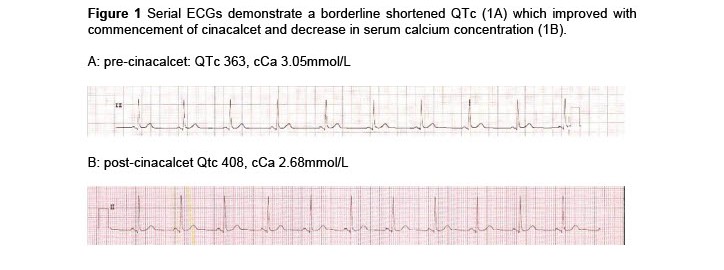
Neck ultrasound and parathyroid sestamibi did not identify a parathyroid adenoma. Renal ultrasound showed normal kidney size without renal calculi or nephrocalcinosis, and DXA revealed normal bone density. Bone turnover markers were within normal limits. Serial ECGs demonstrated borderline shortened QTc of 363ms with paired cCa 3.05mmol/L (Figure 1A). A 24-hour urine collection showed low urine calcium creatinine clearance ratio (CCCR) of 0.003 (4). Repeated 24-hour urine collections confirmed these findings, and FHH was suspected. Genetic testing for CASR and GNA11 was negative. Subsequent testing identified a heterozygous pathogenic AP2S1 variant c.43C>T (p.Arg15Cys), confirming FHH3.
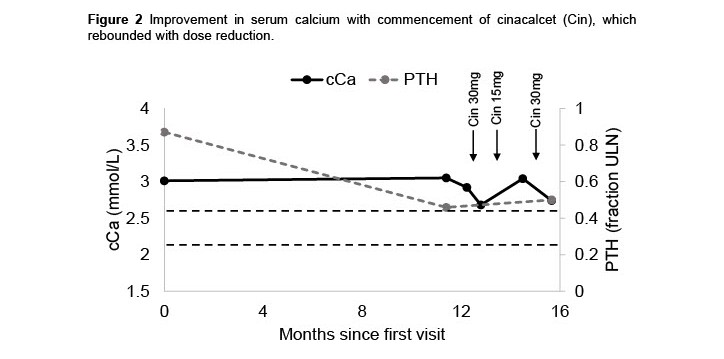
Due to persistent, severe hypercalcaemia, borderline shortened QTc and a recent family history of cardiogenic syncope in the context of clinical Brugada syndrome (later genetic testing diagnosed a novel sodium channel variant), cardiology opinion was sought. Given previous reports of hypercalcaemia mimicking Brugada syndrome (5) and precipitating arrythmia in true Brugada syndrome (6), a decision was made to trial treatment with cinacalcet 30mg nocte. By Day 7, QTc lengthened to 408ms with cCa 2.68mmol/L (Figure 1B). The patient reported substantial symptomatic improvement in energy, thirst, and polyuria without side effects. A subsequent dose reduction to 15mg daily was followed by symptomatic and biochemical relapse, with cCa rising to 3.04mmol/L. Increasing cinacalcet back to 30mg resulted in renewed clinical improvement and reduction in cCa to 2.74 mmol/L (Figure 2).
Case Discussion
We present a case of severe hypercalcaemia secondary to FHH3 with symptomatic and biochemical response to cinacalcet therapy. FHH is usually an asymptomatic disorder of calcium homeostasis not requiring treatment, but there is important phenotypic variability across genetic subtypes. FHH3 is associated with higher plasma calcium than FHH1 despite similar PTH and urinary indices (3), with evidence for genotype-phenotype correlation (7).
Distinguishing FHH from primary hyperparathyroidism is critical to avoid unnecessary surgery (1). In this patient, the combination of strong family history, markedly low CCCR, and negative localisation imaging appropriately supported FHH, later confirmed with genetic testing. While some cases report low BMD and skeletal complications, our patient had a normal DXA and bone turnover markers, highlighting that skeletal involvement in FHH3 is variable (8).
Although FHH has traditionally been managed conservatively, there is growing case-based evidence supporting calcimimetic therapy in selected patients with symptomatic or severe hypercalcaemia (9, 10). Cinacalcet, a positive allosteric modulator of CaSR, has been reported to improve symptoms and reduce calcium in FHH3 without major adverse effects, albeit in small series (10). In our patient, cinacalcet produced a rapid, reproducible dose-response. The observed QTc lengthening alongside calcium reduction mirrors previous experience in FHH1 that calcimimetic therapy may normalise short QT (11).
Conclusions
Compared with FHH1, FHH3 has been associated with more severe, symptomatic hypercalcaemia in addition to metabolic bone and extra-skeletal manifestations. This case demonstrates the key steps for diagnostic work up of FHH, discusses the genotype-phenotype characteristics of FHH, and explores the limited published literature on treatment with cinacalcet for FHH-associated symptomatic hypercalcaemia.
- (1) Lee JY, Shoback DM. Familial hypocalciuric hypercalcemia and related disorders. Best practice & research Clinical endocrinology & metabolism. 2018;32(5):609-19.
- (2) Nesbit MA, Hannan FM, Howles SA, Reed AA, Cranston T, Thakker CE, et al. Mutations in AP2S1 cause familial hypocalciuric hypercalcemia type 3. Nature genetics. 2013;45(1):93-7.
- (3) Vargas-Poussou R, Mansour-Hendili L, Baron S, Bertocchio J-P, Travers C, Simian C, et al. Familial hypocalciuric hypercalcemia types 1 and 3 and primary hyperparathyroidism: similarities and differences. The Journal of Clinical Endocrinology & Metabolism. 2016;101(5):2185-95.
- (4) Marx SJ. Distinguishing typical primary hyperparathyroidism from familial hypocalciuric hypercalcemia by using an index of urinary calcium. The Journal of Clinical Endocrinology & Metabolism. 2015;100(2):L29-L30.
- (5) Zeb M, McKenzie DB, Naheed B, Gazis T, Morgan JM, Staniforth AD. Hypercalcaemia and a Brugada-like ECG: an independent risk factor for fatal arrhythmias. Resuscitation. 2010;81(8):1048-50.
- (6) Nakamura H, Sato Y, Ishii R, Araki Y. A successfully treated Brugada syndrome presenting in ventricular fibrillation preceded by fever and concomitant hypercalcemia. Turkish Journal of Emergency Medicine. 2022;22(3):163-5.
- (7) Hannan FM, Howles SA, Rogers A, Cranston T, Gorvin CM, Babinsky VN, et al. Adaptor protein-2 sigma subunit mutations causing familial hypocalciuric hypercalcaemia type 3 (FHH3) demonstrate genotype–phenotype correlations, codon bias and dominant-negative effects. Human molecular genetics. 2015;24(18):5079-92.
- (8) Baraf L, Averbuch NS, Carmon L, Szalat A, Sukenik-Halevy R, Fraenkel M. Expanding the phenotype of familial hypocalciuric hypercalcemia type 3: Case report and review of the literature. Journal of Clinical and Translational Endocrinology: Case Reports. 2022;26:100137.
- (9) Mayr B, Schnabel D, Dörr H-G, Schöfl C. Genetics in endocrinology: gain and loss of function mutations of the calcium-sensing receptor and associated proteins: current treatment concepts. European Journal of Endocrinology. 2016;174(5):R189-R208.
- (10) Howles SA, Hannan FM, Babinsky VN, Rogers A, Gorvin CM, Rust N, et al. Cinacalcet for symptomatic hypercalcemia caused by AP2S1 mutations. New England Journal of Medicine. 2016;374(14):1396-8.
- (11) Cuny T, Romanet P, Goldsworthy M, Guérin C, Wilkin M, Roche P, et al. Cinacalcet reverses short QT interval in familial hypocalciuric hypercalcemia type 1. The Journal of Clinical Endocrinology & Metabolism. 2024;109(2):549-56.
