 ANZBMS 2026
 Cortical and trabecular microarchitectural deterioration in women with prosthetic hip and knee joint replacement (#17)
Introduction Advancing age is associated with two public health problems, osteoarthritis and osteoporosis. Around 3.7 million (15%) people in Australia have arthritis often requiring primary joint surgery or re-operation due to periprosthetic fractures, loosening or infection1. Over half of the revisions occurred within 6 years of primary surgery. Failure of primary prosthetic joint surgery may be the result of underlying bone fragility. Some studies suggest the presence of osteoporosis predisposes to failed prosthetic surgery. However, bone fragility is not confined to patients with osteoporosis (BMD T-Score ≤ -2.5 SD). On the contrary, most fragility fractures occur in persons with osteopenia or so-called ‘normal’ BMD because most community dwelling individuals have these modest deficits in BMD but may have bone fragility due to microarchitectural deterioration2.
Hypothesis Women with prosthetic joint replacement for osteoarthritis have bone fragility due to microarchitectural deterioration irrespective of their BMD category.
Methods We studied 43 women (age range: 45–84 years) with prostheses and compared them with 92 age- and sex-matched controls. Both the distal tibia and the non-dominant, fracture-free distal radius were scanned using HR-pQCT at an 82 μm resolution. The StrAx algorithm was used to quantify cortical and trabecular microarchitectural deterioration captured by the Structural Fragility Score (SFS)2.
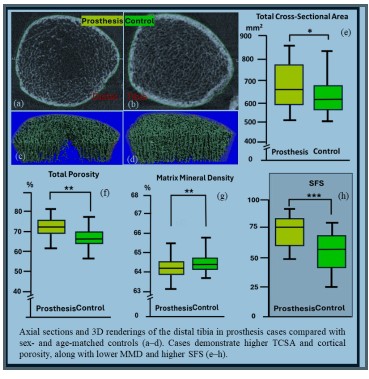
Results Cases had a larger tibial total and medullary CSA with no difference in cortical area. However, cortical thickness and cortical vBMD were lower, the latter due to higher cortical porosity and lower matrix mineral density (MMD). Trabecular vBMD was lower due to fewer and more disconnected trabeculae with no difference in trabecular thickness. Cortical and trabecular deterioration were captured by the higher SFS.
Conclusion Women with prosthetic joint surgery for arthritis have microarchitectural deterioration irrespective of their BMD. Clinical trials are needed to determine whether treatment with anti-resorptive, anabolic agents or both, will preserve or partly restore bone volume and microarchitecture and reduce the burden of failed primary prosthetic joint replacement.
- 1-Australian Institute of Health and Welfare, 2024, Chronic musculoskeletal conditions, AIHW, Australian Government
- 2- Roland Chapurlat, Minh Bui,and Ego Seeman, Deterioration of Cortical and Trabecular Microstructure Identifies Women with Osteopenia or Normal BMD at Imminent and Long‐Term Risk for Fragility Fracture: A Prospective Study, JBMR, 2020
