 ANZBMS 2026
 Reimagining routine health information systems to detect fracture risk and osteoporosis: a policy brief prepared for the World Health Organisation (WHO) (#18)
Introduction: Low trauma (fragility) fractures impose major economic and social burdens, yet wide global variation in health data systems limits the translation of data into actionable insights and a global fracture risk registry. This policy brief was commissioned and prepared for WHO to advise Ministries of Health on leveraging health data to improve osteoporosis screening, monitoring, diagnosis and prevention, to reduce fracture-related morbidity and mortality.
Methods: Twenty-five global experts were identified with 21 invitations from 16 countries accepted. A total of 11 x one-hour virtual interviews were conducted in October-November 2025. A thematic analysis was conducted, beginning with 15 initial codes derived from the WHO Building Blocks and the PRISM framework, with four additional codes added as new themes emerged. Findings were synthesised into barriers and mutually reinforcing policy opportunities.
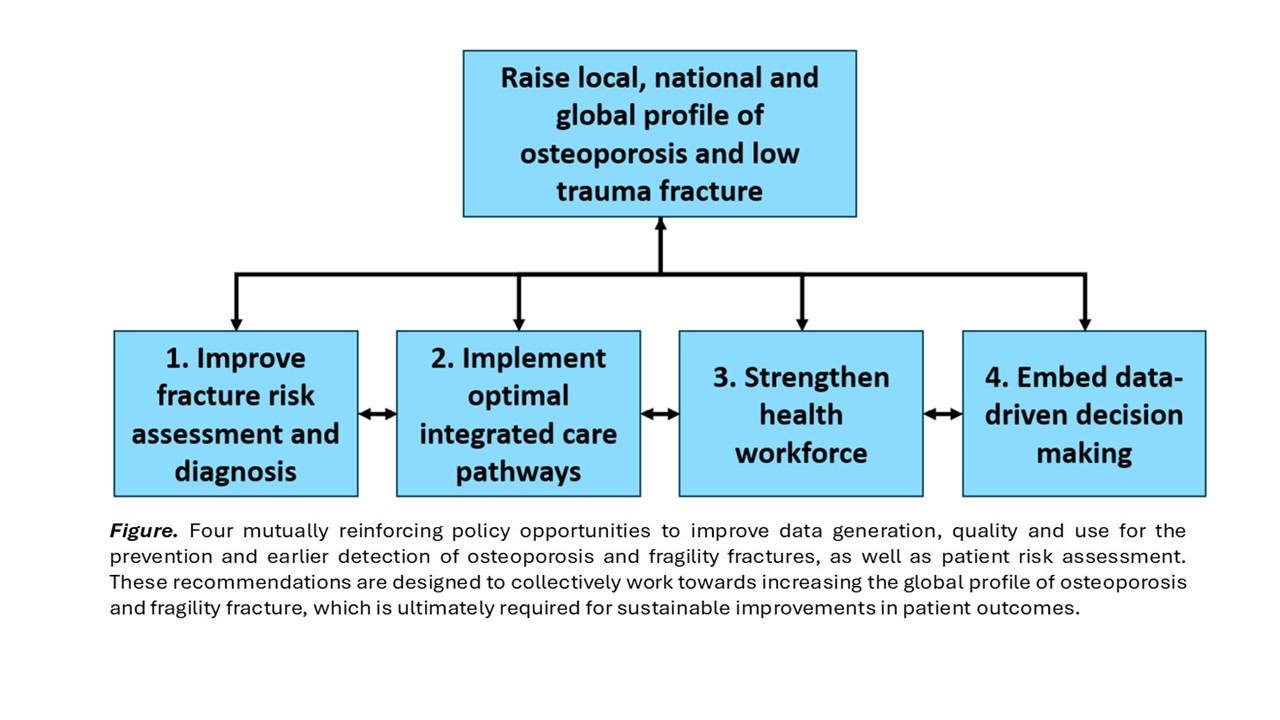
Results: Five key barriers consistently identified included (1) low public awareness and competing health priorities, gaps in (2) diagnosis and clinical care, and (3) workforce capability, (4) fragmented and low-quality data, and (5) implementation complexity and sustainability constraints. To address these barriers and challenges, four mutually reinforcing policy opportunities were presented to increase the profile of osteoporosis and low trauma fractures (Figure). Experts also provided specific recommendations around (1) importance of local osteoporosis management guidelines, (2) minimum dataset and principles needed for local fracture risk registries, and (3) facilitation and integration of resources including digital solutions (e.g., AI, risk prediction algorithms) to bridge workforce and health equity gaps, including opportunistic case finding.
Conclusion: Findings provide practical, feasible, equitable and scalable recommendations to strengthen data systems, workforce capability and governance for Ministries of Health and stakeholders. Emphasising local context-appropriate guidelines, registries and digital solutions appear key to improving awareness of bone health to prevent fragility fractures.