 ANZBMS 2026
 Repurposing FDA-Approved Drugs Targeting OXR1 to Suppress Osteoclastogenesis and Prevent Bone Loss (#6)
Excessive osteoclast activity drives pathological bone loss. We previously showed that oxidation resistance 1 (OXR1) is required for osteoclastogenesis by directly binding to KEAP1, thereby facilitating KEAP1–p62 interaction and promoting p62-dependent ubiquitination and mitophagy. Both siRNA knockdown and myeloid-specific Oxr1 conditional knockout (Lyz2-Cre; Oxr1flox/flox, Oxr1cKO) impaired osteoclast formation and increased bone mass in mice. These findings identified the OXR1-KEAP1 interface as a potential therapeutic target.
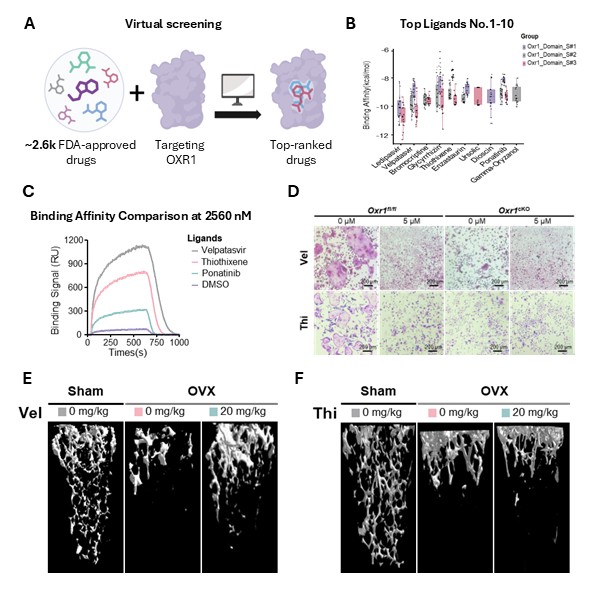
To identify OXR1-binding compounds among existing drugs, we used GPU-accelerated AutoDock4 to screen approximately 2,600 US FDA-approved drugs against the OXR1 protein structure (Fig1. A), targeting three OXR1-KEAP1 interaction domains. Among the top 10 ranked candidates (Fig1. B), we selected those predicted to bind all three domains and validated them by surface plasmon resonance (SPR), which confirmed concentration-dependent binding to recombinant mouse OXR1 protein (10–2560 nM) (Fig1. C). The two strongest binders, the antiviral Velpatasvir (Vel) and the antipsychotic Thiothixene (Thi), were selected for functional validation. In bone marrow macrophage (BMM) cultures, Vel and Thi each suppressed RANKL-induced osteoclast differentiation and bone resorption function in a dose-dependent manner without cytotoxicity, as assessed by TRAP staining and bone resorption assay. Western blotting showed that both compounds reduced NFATc1 and CTSK protein levels during osteoclast differentiation. To assess whether these effects were OXR1-dependent, we compared responses in BMMs from Oxr1flox/flox and Oxr1cKO mice. In BMMs from Oxr1flox/flox mice, Vel and Thi inhibited osteoclast formation and suppressed NFATc1 and CTSK expression; in contrast, in Oxr1cKO BMMs, neither drug produced a further inhibitory effect, beyond vehicle-treated Oxr1cKO controls, supporting OXR1-dependent activity (Fig1. D). To test in vivo efficacy, we administered Vel or Thi by intraperitoneal injection to ovariectomized (OVX) mice. Micro-CT analysis of femurs showed that both treatments preserved trabecular bone volume fraction (BV/TV) and trabecular number (Tb.N) compared to vehicle-treated OVX controls (Fig1. E–F). H&E and TRAP staining of histological sections confirmed better-preserved bone microarchitecture and fewer TRAP-positive osteoclasts in treated mice.
In summary, these data identify OXR1 as a viable pharmacological target and demonstrate that repurposing FDA-approved drugs is a feasible strategy for developing new treatments for osteoclast-driven bone loss.