 ANZBMS 2026
 Using single-cell transcriptomics to identify gene regulatory networks involved in rare skeletal disorders (#10)
Single-cell transcriptomic studies have recently described the landscape of cells located in bone and bone marrow, and defined gene programs that control their function1. Integration of these data with information from human gene-mapping studies of skeletal diseases has identified cells known to regulate bone formation and bone loss, as well as blood vessel cells that have previously had underappreciated roles in bone health. Despite this success, little is known about how the genes expressed in these cells are co-regulated. Addressing this knowledge gap has potential to identify new cellular mechanisms that regulate skeletal health. We developed a framework to: (i) estimate gene-by-gene correlations from single-cell transcriptomics data, (ii) define clusters of co-expressed genes (“modules”), and (iii) predict cell types that contribute to gene expression in each module. We applied our framework to single-cell RNA sequencing data from 118,359 individual bone and bone marrow cells isolated from femurs of 9-10-week-old wildtype C57BL/6J male mice1. Disease-relevant modules were identified based on enrichment of genes known to be involved in rare human monogenic skeletal disorders2. Our framework identified 13 modules ranging in size from 15 to 485 co-expressed genes. Three modules were highly enriched for rare skeletal disease genes (p<9.4×10⁻⁵). The first module was enriched for genes involved in proportionate dwarfism, and enrichment was attributable to cell cycle genes expressed in a variety of cells undergoing proliferation (Fig.1a). The second module was enriched for genes involved in disproportionate dwarfism and encompassed multiple collagen genes originating from growth plate chondrocytes (Fig.1b). The third module was enriched for genes involved in osteogenesis imperfecta, and consisted of a network of interacting genes, originating from endothelial cells, vascular cells, osteoblasts and chondrocytes (Fig.1c). This finding was consistent with our recent study showing that blood vessel cells can interact directly with osteoblasts and chondrocytes to regulate bone (Fig.1d)1. We developed a new framework that has potential to improve our understanding of how genes interact within cells and between cells to regulate bone health. However, further work is needed to benchmark our method against existing approaches and to functionally validate these predictions in vivo.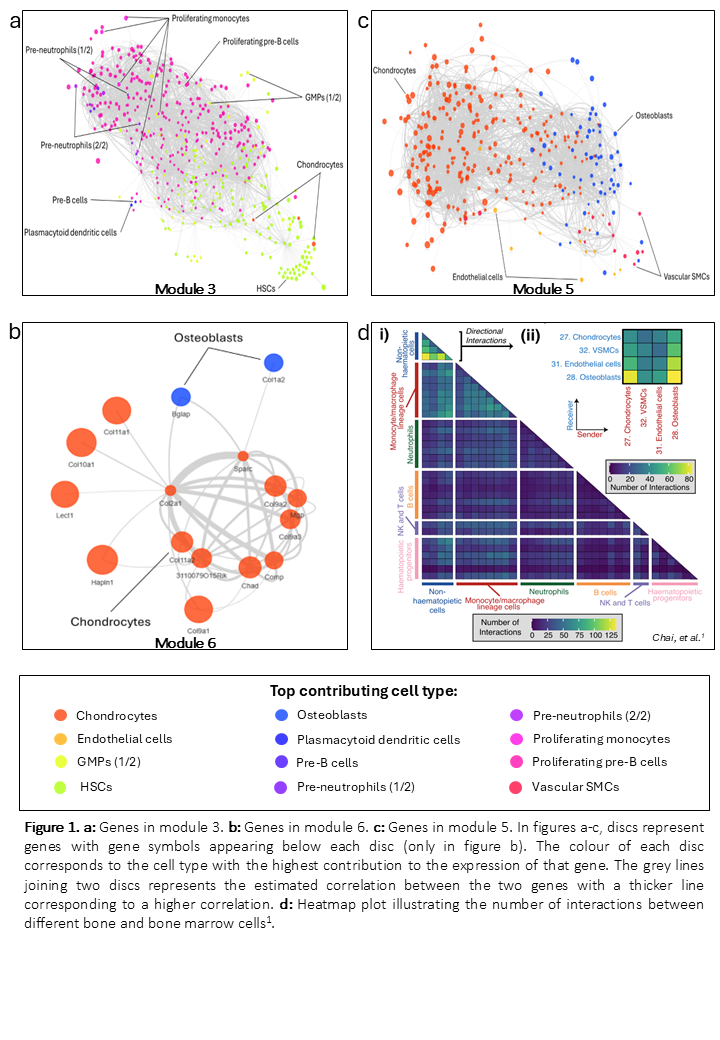
- Chai, et al. (provisionally accepted). Multiscale analysis and functional validation of the cellular and genetic determinants of skeletal disease. Nature Genetics.
- Unger, S., et al. (2023). Nosology of genetic skeletal disorders: 2023 revision. American Journal of Medical Genetics Part A, 191(5), 1164–1209.