 ANZBMS 2026
 Rethinking long‑term denosumab therapy: extending treatment intervals in low‑risk patients (#11)
Denosumab is the most used osteoporosis therapy in Australia. However, uncertainty remains regarding the long‑term consequences of sustained bone turnover suppression beyond 10 years and the optimal duration of therapy, particularly in younger individuals and those at low fracture risk. It is unclear whether strategies that allow partial recovery of bone turnover, such as extended dosing intervals (EDI), may reduce long‑term skeletal adverse effects whilst maintaining bone mineral density (BMD). We assessed the safety of EDI and its ability to preserve BMD following long‑term treatment.
We report 11 women receiving long‑term denosumab in whom the dosing interval was extended from six to 8–9 monthly. All patients had achieved osteopenic or stable osteoporotic BMD prior to EDI, and were considered to have low fracture risk. Potential risks were discussed and all participants provided informed consent.
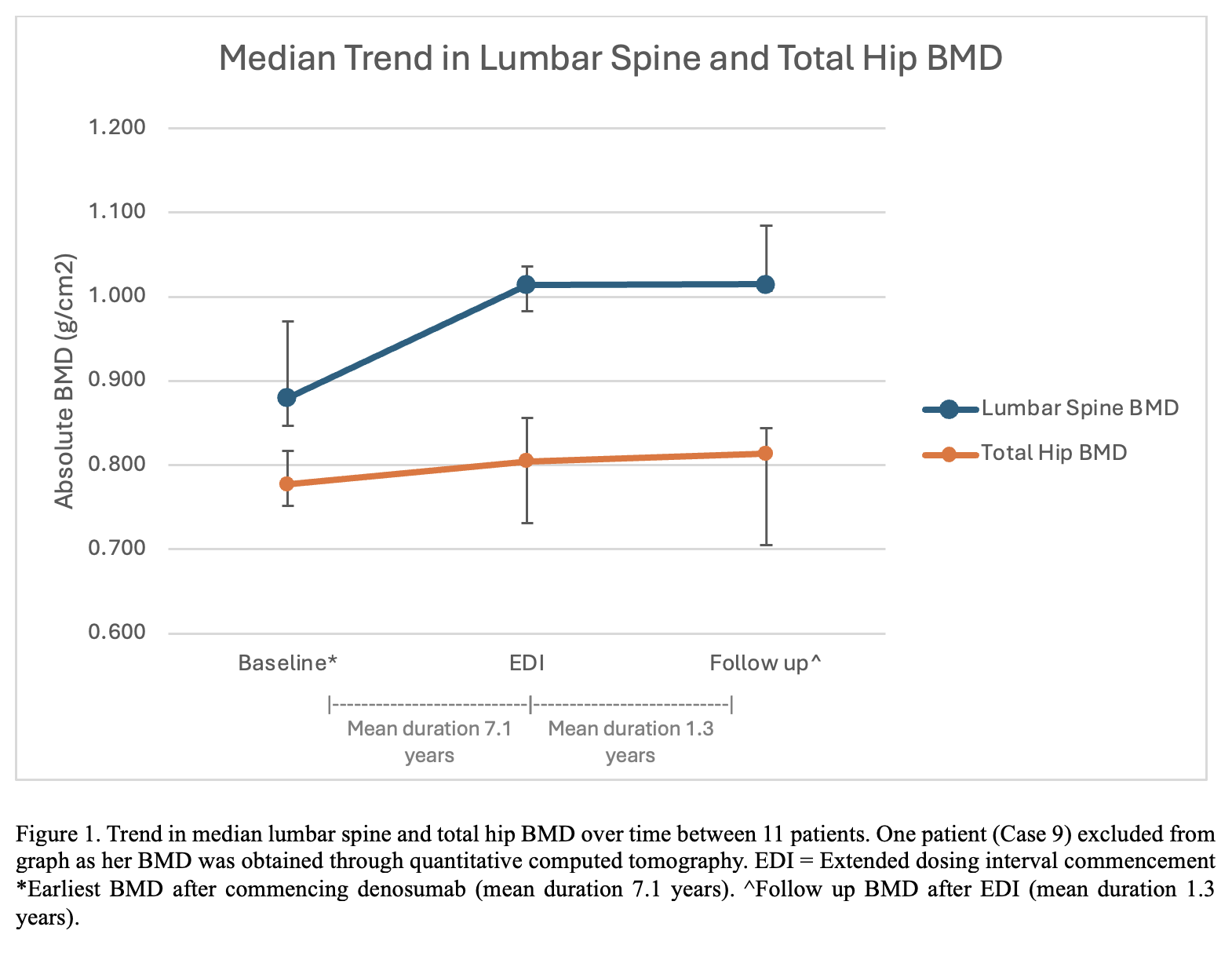
The median age of the cohort was 68 years (IQR 62 to 79), with a median denosumab treatment duration of 9.2 years (IQR 6.8 to 10.8). The median lumbar spine (LS) T-score was -1.3 (IQR -0.9 to -1.6), total hip (TH) T-score -2.0 (IQR -1.4 to -2.4). Eight patients had never sustained a fragility fracture, one patient had vertebral fractures 12 years earlier and one patient had prior rib fractures. One patient had a prior atypical femoral fracture which prompted initiation of EDI. At a mean follow‑up of 1.3 years after interval extension, lumbar spine and total hip BMD remained stable with a median percentage change in LS 0.8% (IQR -1.9 to 1.9) and TH -0.3% (IQR -1.0 to 1.9). Two patients who inadvertently extended the dosing interval to 10 months, lost BMD in both their lumbar spine and total hip. No clinical vertebral or non‑vertebral fractures were observed.
These findings suggest that modest denosumab interval extension may maintain BMD in a population with low fracture risk and require confirmation in a larger prospective controlled study. Given the risks of rebound, these strategies must be cautiously applied, limited to carefully selected patients, and undertaken with close specialist supervision.