 ANZBMS 2026
 Bone Mineral Density Response to Romosozumab in Severe Osteoporosis Associated with Spinal Cord Injury (#203)
Background: Individuals with spinal cord injury (SCI) are at high risk of severe osteoporosis due to profound mechanical unloading. Osteocyte-derived sclerostin is markedly elevated following SCI and suppresses bone formation1. Romosozumab, a sclerostin inhibitor, has established efficacy in postmenopausal osteoporosis2, but its effectiveness in non-weight-bearing individuals with chronic SCI remains uncertain. We report changes in bone mineral density (BMD) following romosozumab in patients with chronic SCI and severe osteoporosis.
Methods: We performed a retrospective review of patients with chronic SCI and severe osteoporosis treated with romosozumab at our centre between January 2021 and March 2025. Nine patients commenced therapy; three non-weight-bearing males (aged 36–45 years, injury level C4–C6, ASIA A, SCI duration 10–23 years) had completed treatment and undergone repeat dual-energy X-ray absorptiometry (DXA) at analysis. All had prior fragility fractures and previous antiresorptive therapy (zoledronic acid and/or denosumab) for a mean of 8 years. BMD was assessed at the total hip (TH), lumbar spine (LS, L1–L4), and femoral neck (FN).
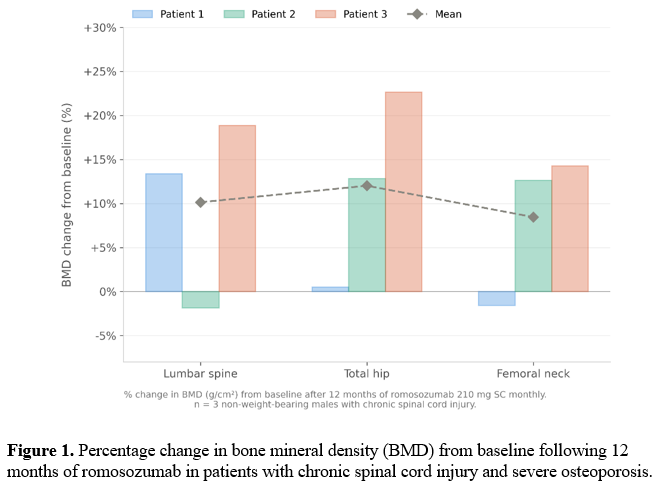
Results: Baseline T-scores ranged from −3.3 to −5.4. TH BMD increased in all three patients (mean 0.297 → 0.327 g/cm²; mean change +12.0%, range +0.5 to +22.7%). LS BMD increased in two of three patients (mean 0.693 → 0.761 g/cm²; mean change +10.1%, range −1.8 to +18.9%). FN BMD increased in two of three patients (mean 0.325 → 0.352 g/cm²; mean change +8.5%, range −1.6 to +14.3%). Response patterns varied: one patient gained predominantly at the hip, one at the spine, and one across all sites. T-scores remained within the severe osteoporotic range despite these gains. One patient sustained an ankle fracture during follow-up.
Conclusions: In this small retrospective series, romosozumab was associated with meaningful BMD gains in non-weight-bearing patients with chronic SCI and severe osteoporosis, consistent with the only prior study in this population3. Responses were most consistent at the TH, suggesting the sclerostin pathway remains partially active in chronic disuse. T-scores remained in the severe osteoporotic range, underscoring the profound skeletal deficit and the challenge of achieving meaningful recovery after long-standing immobilisation. Larger prospective studies are needed to define the role of romosozumab in SCI-related osteoporosis.
- Battaglino RA et al. Circulating sclerostin is elevated in short-term and reduced in long-term SCI. Bone. 2012;51(3):600–5.
- Cosman F et al. Romosozumab Treatment in Postmenopausal Women with Osteoporosis. N Engl J Med. 2016;375:1532–43.
- Crack LE et al. Monthly treatment with romosozumab for 1 year increases bone mineral at the hip, but not the knee, in women with chronic spinal cord injury. JBMR Plus. 2024;8(7):ziae077.