 ANZBMS 2026
 Lactoferrin enhances flucloxacillin activity against Staphylococcus aureus biofilms in periprosthetic joint infections: from in vitro to a rat model (#113)
Background: Periprosthetic joint infection (PJI) is a serious complication of joint replacement surgery, with a reported 46% treatment failure rate in Australia and New Zealand1. S. aureus is the most common cause of PJI, colonizing implants and forming a protective biofilm, which shields itself from antibiotic therapy. Lactoferrin, an 80-kDa iron-binding glycoprotein, is a promising antibiotic adjuvant with anti-biofilm properties. In this study, we aimed to evaluate the efficacy of lactoferrin in combination with flucloxacillin, a first-line antibiotic for S. aureus infections, in the treatment of PJI.
Methods: Firstly, S. aureus Xen-36 biofilms were generated in a standard bioreactor on implant-grade surgical steel coupons and exposed to flucloxacillin with or without lactoferrin. After three days, biofilm structure was visualized by live/dead staining, and viable bacteria were quantified by colony-forming unit (CFU) counting. Secondly, a hydrogel–niosome delivery system was developed using thin-film hydration and HDM-starch incorporation to enable controlled drug release. Thirdly, a PJI rat model was established by inoculation with S. aureus biofilm, followed by implantation of a stainless-steel pin into the tibial medullary cavity. The infected wounds were treated with a hydrogel–niosome system containing different drugs. Seven days later, tibial explant tissues and pins were collected for CFU enumeration. Concurrently, histological assessment was performed using hematoxylin and eosin (H&E), Masson’s trichrome, tartrate-resistant acid phosphatase (TRAP), and Giemsa staining, as well as immunohistochemistry.
Results: Lactoferrin significantly enhanced flucloxacillin activity against S. aureus biofilms in vitro, as evidenced by biofilm structural disruption (Figure 1A) and reduced CFU counts (Figure 1B). This enhanced efficacy was translated into the PJI rat model, with significantly reduced CFUs recovered from bone tissue (Figure 1C) and implant surfaces (Figure 1D).
Conclusion: Lactoferrin shows promise as an anti-biofilm adjuvant for antibiotics. Our findings support its potential use on PJI treatment in combination with flucloxacillin within a hydrogel–niosome delivery system. Further clinical studies are needed to evaluate its translational potential.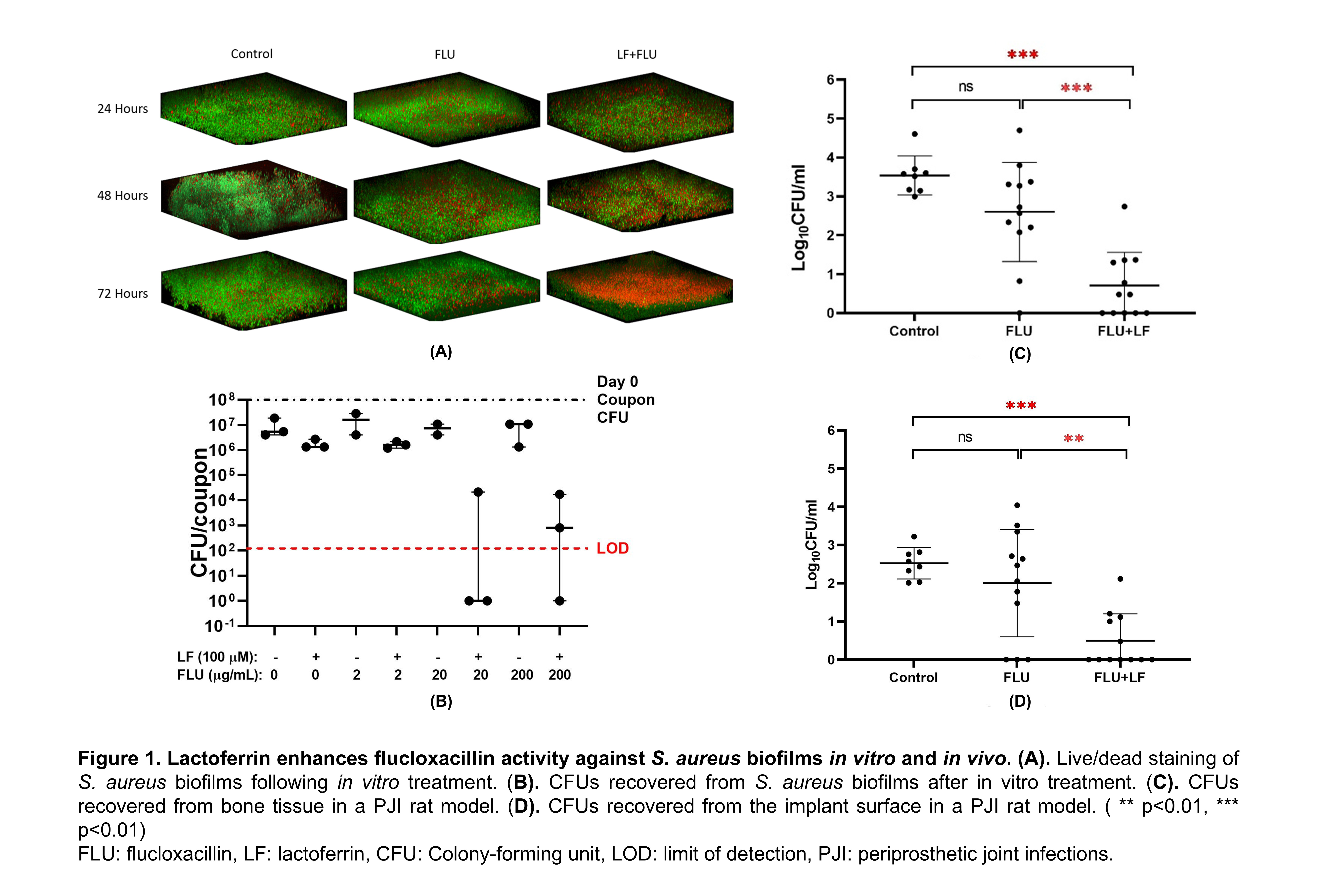
- Davis, J. S. et al. Predictors of Treatment Success After Periprosthetic Joint Infection: 24-Month Follow-up From a Multicenter Prospective Observational Cohort Study of 653 Patients. Open Forum Infect Dis 9, ofac048, doi:10.1093/ofid/ofac048 (2022)